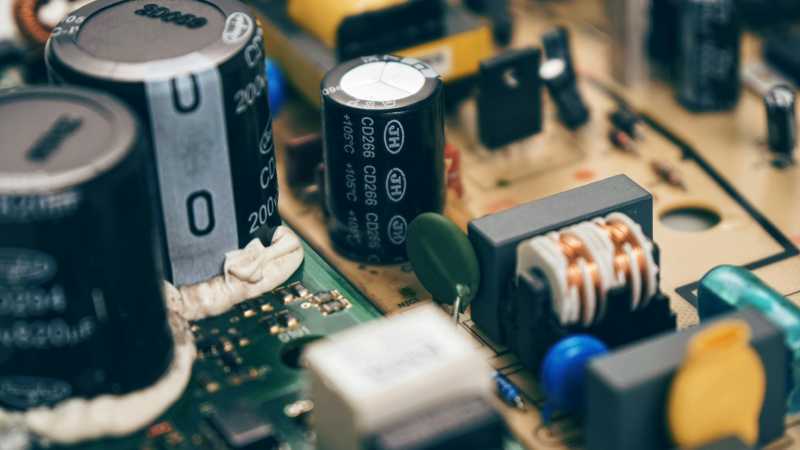
To most people, the intricate array of components that operate within everyday electronic devices such as smartphone screens, car controls, stereos, personal media players and games consoles remain a mystery. Yet in every one of these products there are resistors, capacitors, transistors and many different types of integrated circuit all working together to make it possible for them to function. This book aims to help novices and professionals alike to understand and identify these components.
You might well ask how such a small IC can possibly convert electrical energy into actions as seemingly ordinary as those illustrated above.
The Building Blocks of Modern Electronics
In the electronic world, components are classified into two categories – passive components and active components. Passive components like resistors, capacitors, and inductors manage current and voltage in electronic devices. Passive components are used to filter AC/DC signals in electronic components and store energy.
Resistors are used in electronic circuits to control the current. Without resistors your laptop’s processor would burn up in seconds because it is designed to safely operate within a certain current range. Capacitors store charge for a duration and are used to smooth out the ripples from the power supply as well as to deliver a burst of current when needed.
These active components require power (including gain) to operate. Transistors are the switching devices of the digital world. They can switch on and off at incredible speeds – with the faster devices switching on the order of billions of times per second. Diodes are also considered active components. They allow current to flow in one direction but block it in the opposite direction. The Diode is often used to protect other Semiconductors from reverse voltage that could cause damage.
Where the Real Work Happens
Integrated circuits are the ultimate electronic component: an entire computer that fits on a fingernail. The processor in your smartphone has more than transistors. It has millions or billions of transistors, more than the number of people currently alive — all wired together to perform a task in a matter of milliseconds.
Most Integrated Circuits (ICs) are not completely standalone components and require additional circuit components in order to operate effectively. When bringing up PCBs that contain ICs, the interactions of the PMU, crystal and other local circuit components (such as memory devices including SRAM, flash and hard drive storage devices) can prevent the IC from booting up correctly.
The Supply Chain Reality
For those developing new products requiring the reliable functioning of electronic components, it is critical to gain access to the highest quality components from the most trusted suppliers. Engineers can expect to spend a considerable amount of time pouring over specifications, qualifying samples and building relationships with suppliers, as well as those further down the supply chain who are able to forecast or accommodate potential future shortages. Many companies rely on specialist component distributors who have developed an in-depth knowledge of component quality and availability.
Component failure rates are a significant concern for the reliability of the overall product. Sometimes a single component, such as a capacitor, can cause an entire PCB to fail.
Miniaturization Meets Complexity
As electronics become more complex and shrink in size to fit into the palm of your hand, the tiny surface mount parts need to be micro-soldered with amazing precision. The latest components are small, tiny even, and packed with functions. They require special tools and techniques to assemble them correctly.
When millions of micro-components are densely packed into a relatively small physical space, cooling becomes a significant challenge. In highly-congested designs, EMI also becomes a significant problem, as densely packed micro-components can attenuate or distort nearby signals. Meeting volumetric objectives while achieving desired system performance becomes an agonizing design decision.
As silicon approaches its physical limits, researchers look at alternative semiconducting materials like gallium arsenide and graphene. While these could potentially operate faster and use less power, they require a completely new manufacturing process as well as entirely new devices to make use of them.
Beyond the Circuit Board
Technology is developing at a rapid pace which has led to electronic components ending up in the most unlikely of products. Clothing, shoes and accessories with integrated flexible printed circuit boards which are woven into the fabric to create interactive fashion are becoming more and more popular. Biocompatible electronic components are being implanted in patients for life where they must function for decades or even a lifetime. These components are also being called upon to perform in the automotive industry where higher temperature operation, greater resistance to vibration and isolation from electromagnetic interference are critical. At the same time, components must provide higher signal integrity, tighter tolerances, greater reliability, more functions and a faster design to production cycle.
Every application is unique with differences such as the effect of space radiation in launch vehicles and spacecraft on the one hand, and the goal of minimum cost and tiny package size for products destined for the consumer market on the other. For general purpose use such as instrumentation and industrial products, a longer working life of typically several decades is a significant factor. Low maintenance over this period is generally essential.
Anti-lock braking systems for cars crunch large amounts of data from real-time sensors at the pace of a flashing light. But they are not alone in requiring such fast processing: systems such as washing machine controls also need to handle large amounts of information quickly. But the decisions a washing machine control system makes are rather different from those for an anti-lock braking system. They determine parameters such as the wash temperature, spin speed and cycle length.
Conclusion
Most people know today’s electronics best through their user interface: a touch screen, a control knob, a keyboard or perhaps a mouse. But to fully appreciate what is possible today, one must also consider the hidden layers that support these devices. The power supply circuitry converts AC from a wall outlet to DC or Switch-Mode voltage for the internal logic circuits that manage user input and commands. This online exhibit presents all the individual components and sub-components that go into creating today’s product experience.