
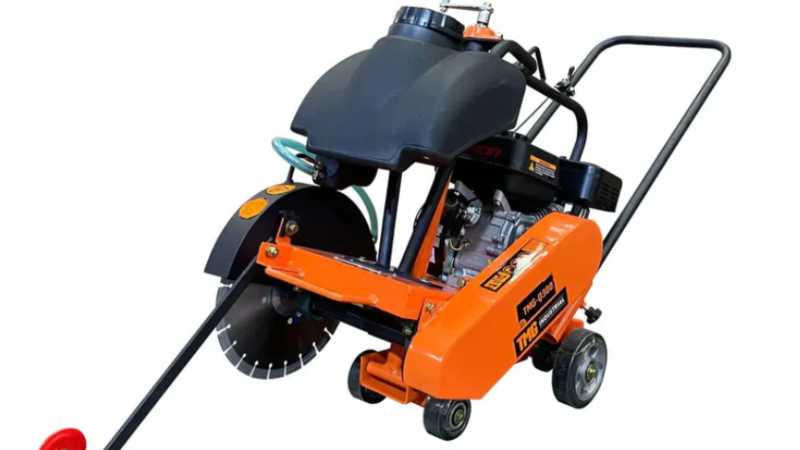
Across Canadian construction sites and municipal maintenance yards, cutting concrete and asphalt is a routine requirement. Expansion joints, utility trenches, and damaged pavement sections all require precise sawing. A heavy-duty walk-behind concrete floor saw provides portable cutting capability for flatwork applications. Canadian contractors, demolition crews, and municipal public works departments use these saws for controlled cutting of pavement, floors, and foundations.
Common Applications and Cutting Methods
The saw uses a 14-inch diamond blade rotating in a down-cut direction. This blade rotation pushes debris downward and helps keep the blade in the cut. The operator walks behind the unit, guiding it along the desired cut line. A top-mounted hand crank adjusts cutting depth up to 3 inches for joint cutting or shallow removal.
Water Cooling and Dust Control
Diamond blades generate significant heat during cutting. Without cooling, the blade would overheat and lose its diamond segments. The integrated water tank supplies water to the blade, providing both cooling and dust suppression.
Water cooling extends blade life by preventing heat damage to the bond that holds diamond segments. For job sites where dust control is required, the water system eliminates nearly all airborne silica particles. This protects both the operator and nearby workers from respiratory hazards.
Proper water flow is essential. Too little water reduces blade life and creates dust. Too much water can create slurry that complicates cleanup. Operators should adjust water flow to produce a light spray pattern visible at the blade.
Technical Principles and Operational Considerations
Several factors affect cutting performance and efficiency. The engine horsepower determines cutting speed through dense concrete. Down-cut blade rotation helps maintain straight tracking. Cutting depth per pass should match blade diameter and engine power. Multiple shallow passes typically cut faster than one deep pass.
Blade selection depends on the material being cut. General-purpose diamond blades work for most concrete and asphalt. For reinforced concrete, blades designed for rebar cutting are more efficient. For green concrete before full cure, softer-bond blades prevent glazing.
Safety Practices and Maintenance Guidelines
Safe operation of a concrete saw requires several key practices:
- Wear hearing protection, safety glasses, and dust mask
- Verify water supply before starting cut
- Check blade for damage before installation
- Allow blade to reach full speed before starting cut
- Push saw at consistent speed without forcing
Maintenance includes checking engine oil before each use, inspecting blade for cracks or segment damage, cleaning water tank and lines after use, verifying blade shaft nut tightness, and inspecting drive belt for wear. The left and right blade mount design allows quick blade changes without removing the entire guard assembly.
Advantages and Limitations
Advantages of a walk-behind concrete saw include:
- 14 inch blade for 3 inch cutting depth
- 6.5 horsepower engine for reliable power
Water tank for dust suppression and blade cooling
- Top-mounted depth adjustment for easy changes
- Pointer wheel for accurate straight cuts
- Lightweight design for transport and handling
Limitations to consider:
- Maximum 3 inch depth per pass
- Not suitable for thick section demolition
- Requires water supply for blade life
- Manual operation requires physical effort
- Limited to flat, horizontal surfaces
Real-World Application Example
A Canadian concrete contractor in Ontario poured residential driveways daily. Control joints were cut with hand tools, resulting in uneven depth and wandering lines. The contractor purchased a walk-behind concrete floor saw. The pointer wheel kept cuts straight. Consistent joint depth prevented random cracking. Homeowner satisfaction improved with professional-looking joints. The saw also cut expansion joints for municipal sidewalk repair contracts.
Conclusion and Future Outlook
TMG Industrial Walk-behind concrete floor saws enable contractors to cut clean, straight joints in flatwork efficiently. Water-cooled blades maintain cutting performance while controlling dust. As concrete construction continues across Canadian residential and commercial sectors, demand for portable, effective cutting equipment will remain strong. Future saw designs may include self-propelled drive systems to reduce operator effort and remote water control from the handle position.
Contractors performing concrete flatwork should evaluate walk-behind saws for any project requiring control joints or removal cuts. The combination of 3 inch cutting depth and water-cooled blade operation makes this saw suitable for diverse Canadian concrete cutting applications.