
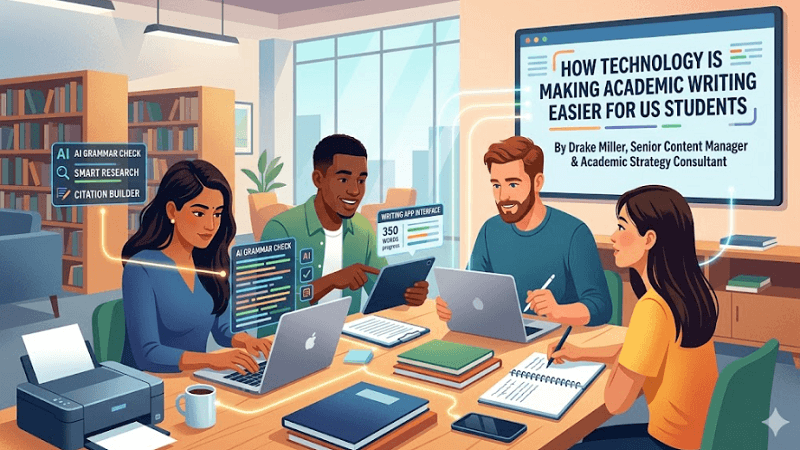
The traditional image of a student hunched over a mountain of library books, frantically scribbling notes on index cards, is largely a thing of the past. In the modern American classroom—whether it’s a high school in suburban Illinois, a state university in Texas, or a lecture hall in Boston—technology has become the primary engine of academic productivity.
For students balancing high GPA requirements with extracurriculars and part-time work, technology isn’t just a convenience; it’s a necessity. Many students now supplement their classroom learning with professional online assignment help to manage heavy workloads effectively. As we navigate the 2026-2027 academic cycle, the digital revolution is making academic writing more accessible, efficient, and sophisticated for students at the high school level and beyond.
1. Streamlining the Research Phase: From Search to Synthesis
Before a single word is typed, a great essay requires robust research. Historically, this meant hours of manual searching through physical card catalogs. Today, digital databases and AI-powered search engines have localized the world’s information, democratizing access for students regardless of their zip code.
Digital Repositories and Open Access
US students now have instantaneous access to JSTOR, Google Scholar, and ProQuest. High school students taking Dual Enrollment or AP courses can access university-level journals from their home laptops. This accessibility ensures that a student in a rural district has the same primary source access as a student at a top-tier private academy in New York or California. Furthermore, for those tackling complex legal precedents or constitutional case studies, specialized law assignment help resources have become essential for interpreting dense statutory language and academic jargon.
AI as a Research Coordinator
New “Agentic” AI tools act as research coordinators rather than just search engines. These agents can scan thousands of PDFs to find specific data points, summarize complex theories, and even suggest counter-arguments. This allows students to spend less time “finding” and more time “thinking” and “analyzing”—the higher-order cognitive skills that US grading rubrics, such as those used by the College Board, prioritize.
2. Real-Time Drafting and Cloud-Based Collaboration
The “lone scholar” model is being replaced by collaborative frameworks. In the US education system, Google Classroom and Google Workspace have become staples of the writing process, from freshman English to doctoral dissertations.
The Power of Google Workspace
The ability to receive real-time feedback from teachers or peer-reviewers is invaluable. Instead of waiting a week for a paper to be returned with red ink, students receive “comments” in the margins as they write. This iterative process mimics modern professional environments in Silicon Valley or Wall Street, helping students improve their syntax and logic on the fly.
Distraction-Free Writing Environments
To combat the digital distractions of social media, many students are turning to minimalist writing software like Hemingway or Scrivener. These tools help students maintain “Deep Work” sessions—a concept popularized by Cal Newport that has become a cornerstone of American academic strategy. By stripping away complex menus, these programs highlight where sentences are too dense or passive, encouraging the “concise and clear” style preferred in US academia.
3. The Evolution of Grammar and Style Assistants
Basic spell-checkers are effectively obsolete. Modern students use sophisticated AI assistants that understand context, tone, and intent.
Beyond the Red Squiggly Line
Tools like Grammarly or ProWritingAid do more than fix typos. For a US high school student, these tools can ensure a tone is “Academic” rather than “Casual.” For a college senior, they can help eliminate wordiness to meet strict word counts for thesis submissions. These assistants teach students the “why” behind a correction, effectively acting as a 24/7 writing expert.
Tailoring to US Academic Standards
Academic writing in the US has specific nuances—such as the preference for the Oxford Comma in many style guides or specific American English spellings (e.g., “analyze” vs “analyse”). Technology ensures consistency across long documents, preventing easy-to-miss errors that could impact a final grade in a competitive GPA environment.
4. Automated Citation and Academic Integrity
One of the most stressful aspects of academic writing is the bibliography. Incorrect formatting in APA, MLA, or Chicago style can lead to point deductions or, worse, accusations of accidental plagiarism.
Citation Generators: Zotero and Mendeley
Tools like Zotero and Mendeley have revolutionized bibliography management. By capturing metadata directly from a browser, these tools allow students to generate perfectly formatted Works Cited pages in seconds. This ensures that the focus remains on the intellectual content rather than the placement of a period in a citation. For graduate students, these tools even manage complex Bluebook or Turabian styles required in Law and History departments.
Plagiarism Detection as a Learning Tool
Plagiarism checkers like Turnitin are often seen as “policing” tools, but for many students, they serve as a final safety net. By running a draft through a checker, a student can identify instances where they may have paraphrased too closely to a source, allowing them to refine their citations before submission.
5. Bridging the Gap with Specialized Support
Even with the best software, some subjects present unique challenges that require a human touch. The integration of online academic platforms has provided a bridge for students who need expert guidance to navigate complex disciplines.
Mastering Complex Disciplines
For example, students tackling Managerial Accounting often struggle with the transition from theory to complex financial data analysis. Similarly, Advanced Statistics requires a level of logical precision that standard grammar tools cannot verify. In these instances, seeking specialized assignment help can provide the structural templates and expert insights needed to move forward.
These platforms complement technological tools by providing human expertise that AI cannot always replicate—especially when interpreting nuanced Constitutional Law precedents or complex financial audits. This hybrid approach ensures students understand the “logic” behind the data, rather than just the output.
6. Accessibility and Inclusive Writing
Technology is a major equalizer for students with disabilities. Speech-to-text software allows students with dysgraphia or mobility impairments to “write” with their voices. Conversely, text-to-speech tools allow students to “hear” their essays, which is a proven method for catching rhythmic errors and logical gaps.
For English Language Learners (ELL) in US schools, translation and vocabulary-building apps provide the scaffolding necessary to compete at the same level as native speakers, ensuring that their grades reflect their ideas rather than just their linguistic fluency.
7. Organizing Thoughts with Visual Mapping
The “blank page” syndrome is one of the biggest hurdles in writing. Digital mind-mapping tools like MindMeister allow students to visually organize their arguments. By dragging and dropping “bubbles” of ideas, students can create a logical flow for their essays before they start the formal writing process. This visual planning leads to more coherent and persuasive arguments, which is essential for the argumentative essays required in AP Language and Composition.
8. Data Visualization and Authoritativeness
In high school and college, especially in STEM and Social Sciences, writing is often accompanied by data. Technology has made it possible for students to create professional-grade charts using Excel, Tableau, or Canva..
9. Preparing for the Future: Agentic Literacy
As we move further into the late 2020s, “Agentic Literacy”—the ability to co-create with AI agents—is becoming a core skill. Students are learning how to prompt AI to generate outlines, explain complex metaphors, or check for logical fallacies. This isn’t “cheating”; it is a sophisticated form of research and development that prepares students for a workforce where AI collaboration will be standard.
Frequently Asked Questions
Q.1 How do I ensure my use of AI doesn’t trigger “AI Detection” flags?
The best way to stay within academic integrity guidelines is to use AI for process, not product. Use agents to brainstorm outlines, simplify complex jargon, or check your logic. When it comes to the final draft, ensure the “voice” is yours. In 2026, professors look for “Personal Experience” and “Critical Analysis”—elements that generic AI outputs often lack.
Q.2 What is the difference between “Search” and “Agentic Research”?
Traditional search gives you a list of links you must read yourself. Agentic Research uses AI agents to read those links for you, cross-reference data across multiple sources, and present a synthesized summary with citations. For a US student, this means the difference between spending five hours on a literature review versus one hour.
Q.3 Can technology help with specialized formatting like Bluebook or Turabian?
Yes. While MLA and APA are common in high school, advanced college courses in Law or History require Bluebook or Turabian. Professional-grade tools like Zotero have specific plugins for these styles, ensuring that even the most complex footnotes are formatted perfectly to US legal and historical standards.
Q.4 Why is “Digital Literacy” being replaced by “Agentic Literacy” in 2026?
Digital Literacy was about knowing how to use a computer. Agentic Literacy is about knowing how to delegate tasks to AI. For the modern student, this means understanding how to prompt an AI to act as a specialized tutor in subjects like Managerial Accounting or Statistics to gain a deeper conceptual understanding.
Conclusion: A Balanced Approach
Technology has undeniably made academic writing “easier,” but it hasn’t made it “thoughtless.” While tools handle the formatting, grammar, and data retrieval, the burden of critical thinking, original argument, and ethical synthesis remains with the student.
By leveraging cloud collaboration, AI-driven research, and specialized academic support services, US students are better equipped than ever to produce world-class scholarship. As these technologies continue to evolve, the barrier between a student’s idea and a polished, professional essay will continue to shrink, allowing the next generation of American scholars to focus on what truly matters: innovation and insight.
About the Author
Drake Miller is a senior content manager and academic strategy consultant with over 12 years of experience in the higher education and digital content sectors. Based in the USA, Drake specializes in the integration of Agentic AI and Large Language Models (LLMs) into modern academic workflows. As a leading voice in “Agentic Literacy,” he works closely with educational platforms and universities to develop future-proof success guides for students navigating the 2026-2027 academic cycle